
Nothing to Check
How long the human lasts comes down to one question. Venture fails it.

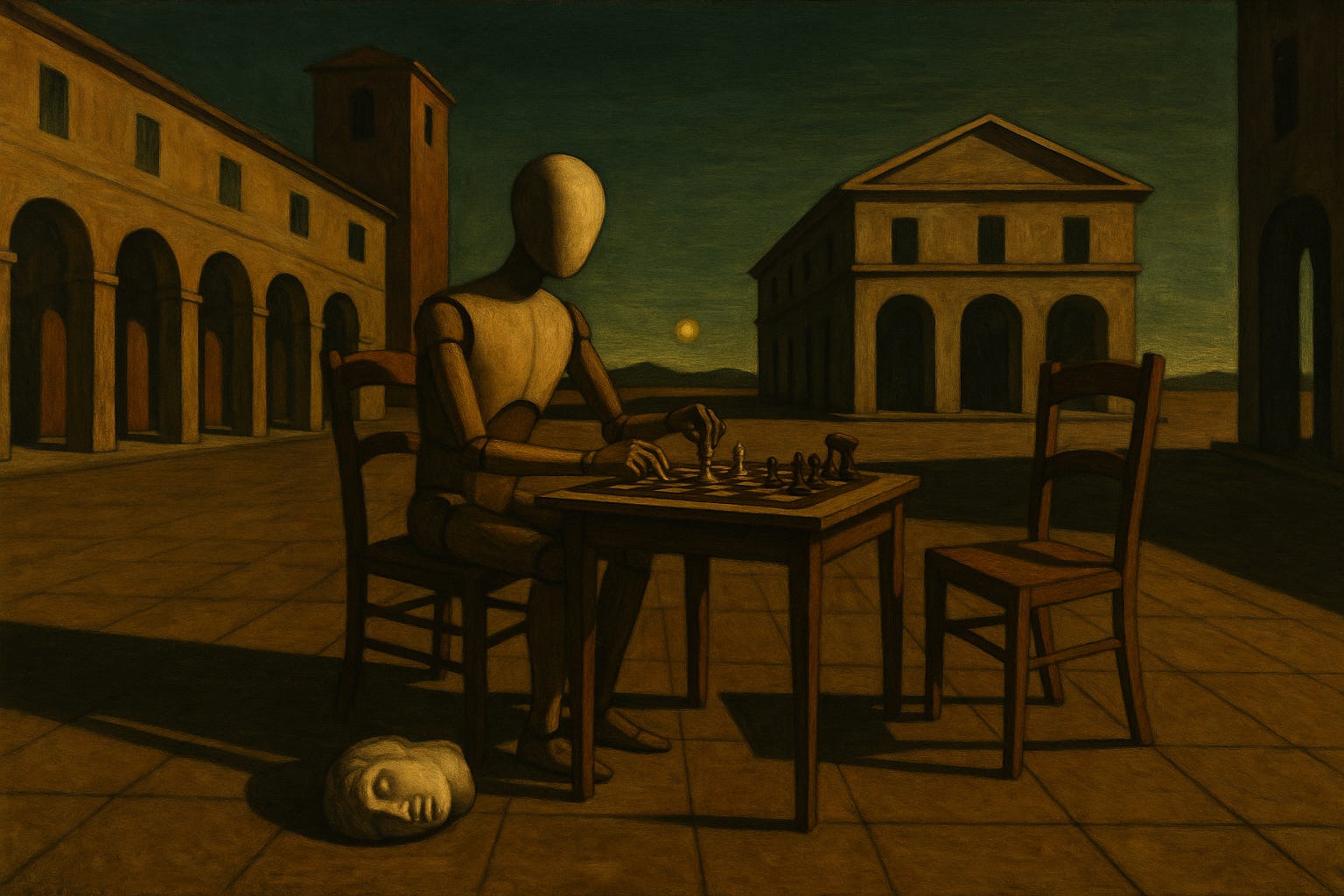
Earlier this year, during a conversation on the New York Times podcast Interesting Times, Dario Amodei, the CEO of Anthropic, described where the work of software engineers stands today. “We’re already in our centaur phase for software,” he said, and warned the period “may be very brief.” The centaur is the old chess term for a human paired with a machine, and the centaur era is the stretch when that combination beats either the human or the machine playing alone. It is a temporary arrangement by definition. The era lasts until the machine gets good enough that the human stops adding anything and starts getting in the way.
Amodei is not the only one reaching for this metaphor. Others have written about the centaur era of AI, and the phrase has become a common shorthand for the interval when a person still improves on the machine but not for much longer. The frame is a good one. What none of them names is what determines how long the era lasts. It is specific to each domain, and for venture capital the answer is one most VC partners would rather not sit with.
Chess is the one centaur era that has already run its full course, so start there. Kasparov coined the arrangement himself: in 1998, a year after losing to Deep Blue, he proposed Advanced Chess, one grandmaster-and-engine pairing against another. For two decades the pairing was the one to beat. In open “freestyle” events, amateurs running a better process on ordinary laptops beat grandmasters with stronger engines, which is what Kasparov meant in 2010: “Weak human + machine + better process was superior to a strong computer alone.” The better process was not metaphor. It was the scoreboard.
Then it ended, without an announcement. The engines just kept getting stronger. By December 2017 DeepMind’s AlphaZero had taught itself to beat the strongest conventional engine outright, and in freestyle play a bare engine had begun beating the human-plus-engine teams. After 2018 there were no more major human-plus-engine tournaments, because the format had run out of reasons to be held. It lasted roughly twenty years.
The same pattern is visible outside of games. Tesla shipped Autopilot in October 2015, and supervised autonomy spread across most major automakers from there. By 2026 it is now past its tenth birthday and still the dominant mode for tens of millions of vehicles, even as Waymo’s no-supervisor service crosses the line in a handful of cities. It is a long era, only now starting to erode away.
In my previous Carried Away post, The FICO Heresy, I argued that human discretion in consumer lending got exiled to the tail of the distribution, and that the same compression is now visible in venture capital. The centaur story sharpens that argument further, because a centaur era can skip the tail entirely. Sometimes it never forms at all, and the role drops to nothing. In chess and in driving, the human role ran long; elsewhere it barely ran.
In the game Go, the human role survived barely two years. AlphaGo beat Lee Sedol in March 2016; AlphaZero generalized the method some twenty months later. No major tournament was ever organized around the human-plus-engine format, because the threshold crossed too fast for one to form. The same held outside games: when DeepMind’s AlphaFold 2 solved protein-structure prediction in 2020, on a problem the field had treated as fundamentally hard for fifty years, the expert-refining-the-model arrangement compressed almost at once to a tail of cases the machine could not handle alone. There was no decade of expert-plus-AI bracketed in between.
What sets the duration is legibility. Chess is calculation against an enumerable state space, where even a grandmaster can articulate why a move is good and second-guess an engine that misses something positional. Driving sits on the same side: a person can watch the road and judge when to take the wheel, which is why supervised autonomy has already run more than a decade. Go is pattern recognition across a state space too large to enumerate, where the strongest players describe their best moves as intuition they cannot justify.
Where the human’s contribution is legible, where the person can spell out and check the machine’s work, the era runs long. Where the contribution is intuition no one can articulate, the machine crosses the threshold and there is often little for the human to pick up.
AlphaGo’s Move 37 against Lee Sedol was calculated to occur about once in ten thousand games among human players. It was not a move the human could have suggested, evaluated, or overruled.
VC partners do many things: sourcing, evaluation diligence, portfolio construction, founder coaching. But the piece that determines an exceptional investment is intuition they cannot fully articulate: reading a founder, calling the unusual bet, naming the market that does not yet exist. A skeptic will say this is not really intuition at all, just knowledge no one has bothered to write down. The tell that it is more than that: when two good partners read the same founder and disagree, they cannot resolve it by trading reasons, because the reasons were never the whole of the call. A Go professional cannot teach you Move 37 either.
On this dimension, the pattern recognition is most of the task, and it is the illegible kind. When a model develops competence at it, there is not much legible left for the VC partner to add on top. The intuition was the work.
The centaur era duration is not something a field gets to choose, and the people inside it rarely know in advance which case they are in. Chess and driving ran long. Go and protein folding barely ran at all. Plenty of a VC partner’s job will keep a human in the loop for years. The part that determines the returns will not. Every “AI plus the partner” setup in venture capital quietly assumes ours is the long case, with the partner staying essential for years to come.
But venture’s core judgment is the illegible kind. We do not actually know we are the chess case, and we have reason to suspect we are the Go case.
The centaur era of chess lasted twenty years. The centaur era of Go lasted nearly zero. In VC, we do not get to choose.
Fascinating analogy.
I wonder where learnability comes into play? Is the vc side missing cheap, verifiable, self-generated ground truth that helped make the other scenarios possible?
Great essay!
Suppose machine-led investment committees do start to dominate. Do you imagine the Board of Directors structure remains in place? Will it remain human? How much if any of VC fund returns do you ascribe to Board service? How does that split between coaching and oversight to founder vs. soft information gathering that informs the fujd's later follow on decisions?